Which Website Architecture Decisions Can Affect Both E-commerce SEO and Conversion Rates?
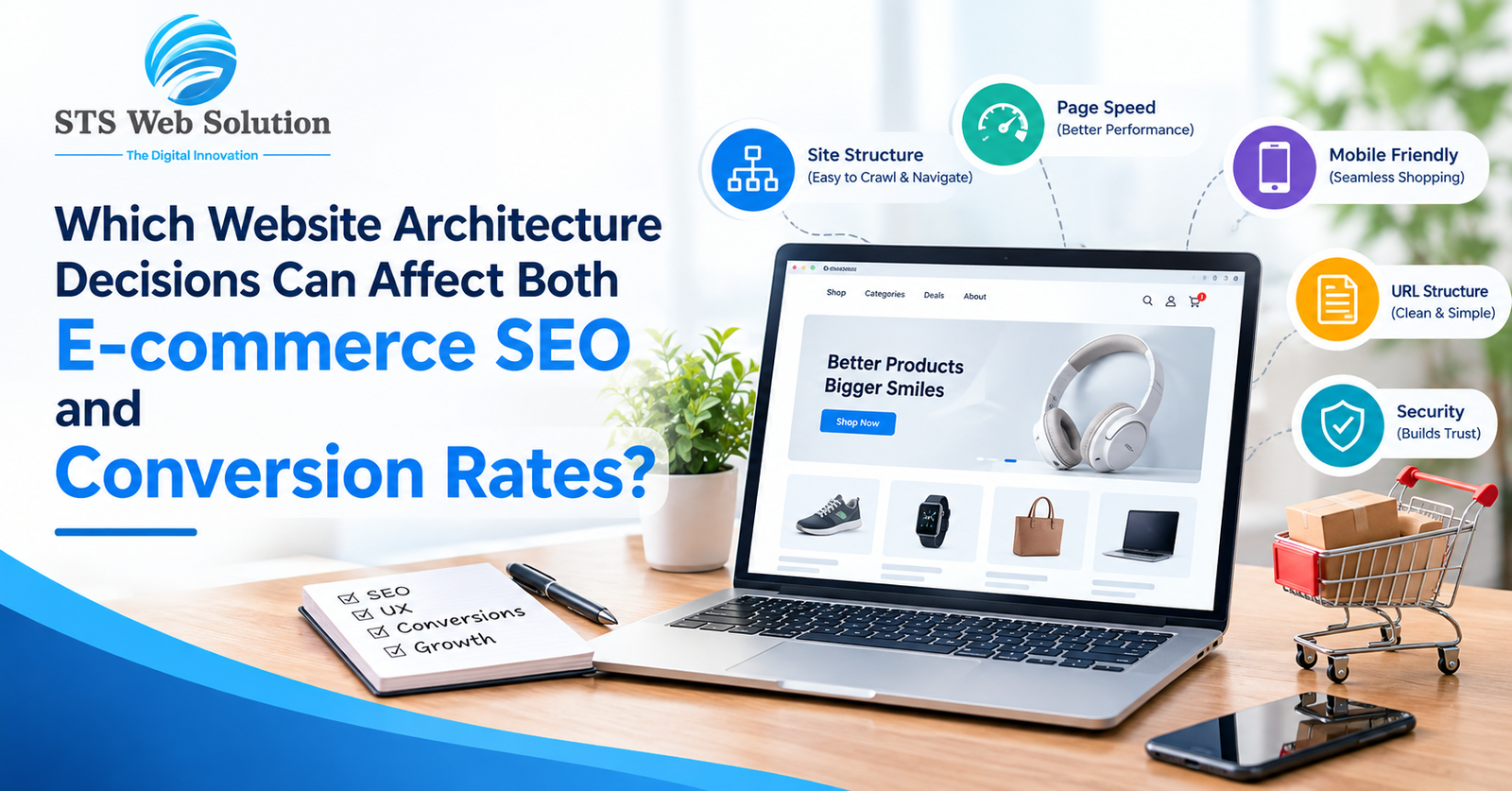
Website design alone does not guarantee success for online shopping sites. Website structure affects the way search engines index the products, the way consumers navigate the product categories, and the ease with which the consumer can complete the transaction. Website structure may negatively affect the efficiency of online shopping sites because it may hinder the visibility of key product pages, as well as increasing the consumer's bounce rate. Companies looking for Best Website Designing Services in Gurgaon should consider website structure.
STS Web Solution is aware that technical optimization, ease of navigation, and business objectives should be taken into account while developing an efficient website. The architecture of a website is made up of the organization and the navigation from one page to another in the website. The technical SEO aspect for e-commerce sites includes item categorization, product URL structure, internal linking, navigation, mobile site, and the checkout process. It all impacts how search engines and users view the site.
How Website Architecture Supports E-commerce SEO and Conversions
The properly designed architecture allows search engines to index the required pages and understand the relationships between the product and the category. It will also assist customers in finding the right products without making extra efforts. For example, an online fashion store can categorize its products as men’s clothes, women’s clothes, shoes, and accessories. Every category may have its own subcategories.
There are many complications that can arise from an unclear architecture. For one, customers may find it difficult to find the products they want, and search engines may find it difficult to find the right pages. It is important to come up with an architecture that makes sense for both users and search engines. Pages should be easily found, information about products should be easily accessible, and actions should not require many steps.
1. Category Hierarchy and Website Navigation
Category Hierarchy is one of the most critical architectural choices in designing an online shopping site. This will determine how items are classified and how users navigate from one section to another. With an efficient hierarchy, users would naturally flow through your website. An example of this is the classification of web pages into “Home,” “Furniture,” “Bedroom Furniture,” and “Beds” on a furniture website. Users would be able to go through categories without returning back to the home page. From an SEO point of view, this makes it easy for search engines to understand the relationship between the categories and product pages.
Businesses should not create more category levels than necessary. If consumers need to go through many pages before finding a product, navigation becomes tiresome. But lumping non-related products in one category will make navigation complicated for users. The best way is to group categories depending on user needs, product relations, and search habits. One way to do that is to incorporate breadcrumb navigation.
2. URL Structure and Product Page Organisation
URLs on webpages have a big impact on how pages are categorized and structured. Well-defined URLs will enable the user to determine what a particular webpage has in store while making the whole structuring of the website easier for search engines to understand. Take, for instance, a URL that ends in a category like '/mens/shirts/cotton-shirts'. This is more specific compared to long URLs that have parameters which are not clearly defined. Webpages in the e-commerce field must have guidelines on URLs for categories, sub-categories, and products. Frequent changes to this policy may result in dead URLs and duplicate URLs, among other problems. There is no need to create unique URLs for various product variations that do not bring unique search benefit.
Where URLs have to be changed, the right kind of redirect must take the user and the search engine to the right destination. Canonical tags can also suggest which URL is the preferred one where similar pages are available via different URLs.
3. Internal Linking Between Categories and Products
Internal links help in linking related pages and enable users to find out more about various products. Such links will provide crawlers of search engines an avenue for crawling the website and knowing which pages are vital. For instance, in the case of an online electronics shop, one may link the category of laptops to some accessories that work effectively with the laptops. Links should be placed among pages that have a real connection, not just in order to create many links. Category pages should link to products, while product pages may link to complementary products.
Products that are essential in nature should never be separated from other parts of the website. In case there is a low level of internal linking on some web page, the chance is high that it would be more difficult for customers and search engines to find. The internal linking strategy brings numerous benefits such as better navigation and purchase options.
4. Mobile-Friendly Design and Responsive Architecture
First of all, users get acquainted with the design. In case the website features lots of zoomable elements, complicated navigation, or poor visual elements on smaller screens, the user might simply close the page without even viewing the items it presents. The responsive design lets one adjust the layout based on the screen size. The navigation, product images, filters, and checkout forms must work properly for all kinds of screens. Mobile usability is of critical importance for SEO, as Google indexes the site based on its mobile version.
Businesses need to focus on the size of buttons, readability of text, product image display, and easy navigation. Filters should not obstruct important information while still remaining visible, and customers must be able to conveniently place items into their carts. Mobile design simplifies the process of finding products and creates less friction in the buying process. When assessing Best Website Designing Services in Gurgaon, businesses need to think about mobile usability as well.
5. Page Speed and Technical Performance
The performance of a website influences the customer’s shopping experience on it. Slow-loading category pages, images, and checkout options may be perceived negatively by customers and affect their willingness to stay on the website and shop on it. Large image sizes, extra scripts, third-party integrations, and inefficient code are among the factors that cause slow loading. These factors become especially obvious when users are browsing products or applying filters while being on a mobile internet connection. The technically sound architecture of the website should provide fast loading of images, browser caching, optimized code, and proper hosting.
Improved page speed will reduce frustration while browsing and make it easy for clients to navigate from one product to another. The improvement should be based on user experience and not on the single speed metric. Testing is necessary since new applications and tracking tools might impact the site's performance.
6. Faceted Navigation and Duplicate Content Management
Facets enable consumers to filter down products based on various criteria like price, brand, size, color, and others. But unorganized facets can end up creating thousands of URLs that do not provide any unique value to search engines. For instance, if various facets are selected on a shoe-related website, the combinations of different sizes, brands, and prices will create different URLs. And, if these are all indexable, the search engines may waste their time accessing these pages rather than accessing more valuable ones. Business owners have to make decisions about which of these facets need to be indexed.
Using canonical tags, crawl controls, and consistency of URL usage will help; however, this depends on how they implement it on their site. The reason is that there needs to be careful thought on how to do these actions because stopping the crawlers won’t always fix the index problem.
7. Checkout Architecture and Purchase Completion
A web page may draw visitors via organic search but fail to convert them into buyers because of a poorly designed checkout system. Superfluous steps, lack of delivery details, additional costs, and complicated forms may put off shoppers from making the purchase. In such cases, the checkout structure must be focused on clarity and ease. It is important that customers are able to check their order, find out the total cost, choose suitable ways to pay, and fix mistakes easily. A guest checkout can also be useful for buyers who don’t wish to sign up.
Checkout pages have a distinct role from the product and category pages from an SEO standpoint. They need to be dealt with in the right way in terms of how they are crawled and indexed by the website. While checkout optimization doesn't necessarily guarantee improved rankings, they allow companies to get the best out of the traffic that they are generating through SEO.
8. Structured Data and Product Information
Search engines can use structured data in order to make sense of specific information related to the products or any other data present on the website. The relevant structured data about the products can be used to pass along the following information as prices, availability, rating and product ID in case there is one. Product information may also be helpful in making purchase decisions.
It is important for companies to make sure that the structured data aligns with the visible data. Errors such as wrong prices, availability, or even reviews can cause inconsistencies. Product schema does not necessarily mean better search results or better rankings. However, when implemented correctly, it will help search engines understand product data.
How to Choose Website Designing Services in Gurgaon for E-commerce Growth
Selecting a partner for website design goes beyond simply looking at web designs or comparing costs of development. Companies need to assess whether the firm knows about technical SEO, consumer behavior, mobile usability, and the business goals of the online store. This means considering a development strategy where the architecture of the website takes precedence over page design. How will the categories be structured? What about URL strategies, internal links, product filters, redirects, and the checkout process? Also, it’s good to know about the testing process after launching the website and future product integration.
Best Website Designing Services in Gurgaon Should Align Their Designs According to Customer Needs and Search Engines. A well-designed website is essential; however, the design of the website must also make it easy for customers to search for and purchase their desired product. It is recommended that businesses examine the website navigation, products, mobile experience, pages, and checkout processes.
Conclusion
The web architecture is important when it comes to e-commerce SEO and conversions. The category structure, URL structure, linking, mobile usability, speed, filtering, and checkout will all influence how customers experience your online store and how the website is perceived by search engines. Businesses that decide to hire Best Website Designing Services in Gurgaon can have their websites designed in such a manner that they will be beneficial for increasing product discoverability, SEO visibility, and making the purchasing process simpler for customers. Companies need to regard web architecture as an investment in the future. The STS Web Solution can be looked at by enterprises wanting to design a website based on usability, technical architecture, and profitability. With well-thought-out architectural considerations from the start, e-commerce enterprises can construct a site that will serve their consumers as well as maintain a sustainable search presence.
Frequently Asked Questions
Website architecture means the way in which the web store structures its categories, product pages, navigation, URLs, and internal linking. A proper structure will help customers locate products, while it will enable search engines to locate significant pages.
The structure of the website will help customers to navigate through different products, compare them, and make a purchase. Proper navigation, faster-loading pages, and a simplified checkout procedure will decrease customer frustration.
Internal linking will connect related categories, products, and other useful pages. This will help search engines to index your content and customers will be able to browse related products without returning back to the home page again and again.
Mobile-friendly design allows adjusting website designs depending on the screen size. Thus, it makes navigation menus, product images, filters, and checkout forms easy to use for mobile devices, making customers’ shopping more comfortable.
The problem of duplicate content on e-commerce sites can be solved by the means of using proper URL formats, canonical tags, and filter settings.
Ready to Transform Your Digital Presence?
Whether you are launching a new brand or redesigning your website, STS Web Solution can help you balance performance, UX, and conversions.
Get Started Today